Pool fencing rules catch more homeowners off guard than almost anything else in the build process. Here is what you need to know before the excavator arrives.
Top Tips • Latest News • Offers • Competitions • Prizes • Giveaways and lots more!!!

Top Tips
Latest News
Offers
Competitions
Prizes
Giveaways
And lots more!!!
There is a common pattern that plays out with pool builds across the Newcastle and Hunter Region every single year. A homeowner does their research on pool shapes, finishes, and lighting, locks in their builder, and then treats the fencing as something to figure out later. It feels logical at the time. The pool comes first, the fence comes after. The problem is that councils and certifiers do not see it that way, and by the time a non-compliant fencing situation surfaces, the build is already mid-swing and the budget has nowhere comfortable to go.
Australian Standard AS 1926.1 sets out the minimum requirements for swimming pool barriers nationally, and New South Wales applies these through the Swimming Pools Act 1992 and the Swimming Pools Regulation 2018. These are not loose guidelines open to interpretation on the day of inspection. They are specific, measurable, and enforced. A failed compliance inspection does not just mean a letter in the mail. It means a hold on your occupation certificate, potential re-work costs, and a delay that can stretch from days into weeks depending on how backlogged your local council is at the time.
Check out our reviews!

Adam from Coastline helped us with our new pool. Great service & advice. Pool was planned, approved and built before my friends was even approved. Have referred them and will continue to do so
Christopher Bell
Our initial consultation with Adam was easy, informative and very flexible to suit our pool needs. The install was just as easy, the process was fully mapped out and broken down making it a seamless experience.
Browns
I have been using Coastline Pools for about 5 years now, probably 2 years after I put my pool in. Then, being new to what to do to maintain my pool the Coastline staff at Raymond Terrace have been fantastic.
Colin Butters
Adam gave me great confidence around tricky elements that other companies couldn't get past. They know what they are doing and deliver a high quality pool. Definitely a company to install your new pool!
Nomy Lou Halifax
It's clear they take pride in their work, and I wouldn't hesitate to recommend them to anyone looking for top-notch service. Thanks again to the entire team at Coastline Pools!
Scott Curran


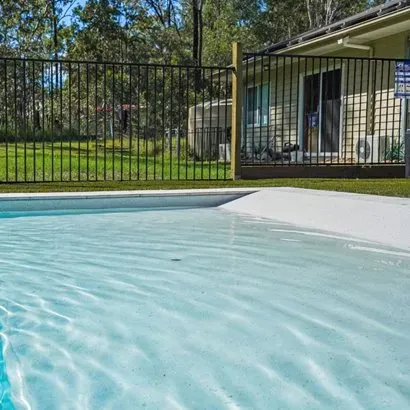
The core requirements are worth understanding clearly. The barrier surrounding your pool must be at least 1,200 millimetres high, measured on the outside of the fence. That measurement matters because the outside face is where a child would be approaching from, and it is the face inspectors measure against. Any horizontal rails or footholds on the outside of the fence must fall within what is called the non-climbable zone, which runs from 900 millimetres down to ground level. If a fence design has a mid-rail sitting at 600 millimetres on the outer face, that is a climbable foothold and it will fail. Gaps between vertical palings or bars must be no greater than 100 millimetres, again to prevent small bodies from squeezing through. Gates are held to an equally firm standard. Every gate in a pool barrier must be self-closing and self-latching, opening outward away from the pool, with the latch positioned on the pool side and at least 1,500 millimetres from the ground, or shielded so a small child cannot reach it from outside. A gate propped open, even temporarily during a party, is a compliance breach. The mechanism itself must be capable of closing and latching from any open position without assistance. Beyond the fence itself, the non-climbable zone concept extends to the surrounding environment. Garden furniture, retaining walls, raised garden beds, air conditioning units, and even certain tree branches within 900 millimetres of the fence can be treated as climbing aids by an inspector. This is why a compliant fence design has to account for the finished landscaping and site conditions, not just the fence panels in isolation. Getting that picture clear before construction begins is far easier than redesigning after the pool is full and the plants are in.
What To Do Next
If you are planning a pool build right now and hoping to be swimming before Christmas, the timing conversation is worth having honestly. October is when that December deadline starts to either hold or slip. A standard pool build in the Newcastle and Hunter Region moves through excavation, shell installation, plumbing, electrical, tiling, coping, and commissioning, and fencing compliance sits at the end of that chain as a gate to your occupation certificate. Any delay there does not just push back a paperwork date. It pushes back the day your family can legally and safely use the pool.
The single most useful thing you can do right now is bring your fencing plan into the design conversation early, ideally before the build contract is finalised. That means knowing your site boundaries, understanding any existing structures or landscaping that sit near the proposed pool barrier, and confirming which type of fencing you want, whether that is glass, aluminium, timber, or a combination, and whether it meets the height and non-climbable zone requirements as designed, not just in theory.
If you have an existing property and you are adding a pool, walk the site with fresh eyes. Note anything within 900 millimetres of where the fence line will run. Retaining walls, steps, built-in planters, side gates, and even metre boxes can all affect compliance. Identifying these early means they can be addressed in the design phase rather than on inspection day.
It is also worth understanding your local council's specific process. In New South Wales, pools must be registered on the NSW Swimming Pool Register, and a compliance certificate from an accredited certifier is required before the pool can be used. Some councils have additional local requirements or inspection timelines that are worth confirming upfront. Your builder should be able to walk you through the certification pathway for your specific location.
At Coastline Pools, we work through these conversations at the planning stage because experience has shown us that a build without a clear compliance pathway is a build with an uncertain finish line. We want your pool ready for that first hot December weekend, not sitting behind a council hold because a gate latch is on the wrong side of the fence.
If you are ready to start planning or you have questions about how fencing compliance applies to your specific site, get in touch with our team. We are happy to talk through your block, your timeline, and what a realistic path to a compliant, finished pool looks like for your home.
Join us to find out more!
Contact Us
We will get back to you as soon as possible.
Please try again later.
Find all the latest news and offers from the Coastline Family!